
Quality Aluminium. Consistent Supply. On-Time Delivery.
Quality Aluminium. Consistent Supply. On-Time Delivery.
Stainless steel pipes are essential components in industrial piping systems where corrosion resistance, durability, and reliability are critical. ASTM A312 TP 304 / 304L ERW pipes are widely used austenitic stainless steel welded pipes designed for high-temperature service and corrosive environments. These pipes are manufactured according to the requirements of the ASTM A312 stainless steel pipe specification, which covers seamless, welded, and cold-worked stainless steel pipes used in pressure systems and process industries. Rajendra Tubinox manufactures ASTM A312 TP 304 and TP 304L ERW stainless steel pipes using modern Electric Resistance Welding technology. This manufacturing process produces pipes with consistent wall thickness, accurate dimensional tolerance, and strong weld integrity. As a result, ERW pipes are widely used for transporting fluids, gases, chemicals, and process media across various industrial applications.
The TP 304 grade is one of the most commonly used stainless steels because of its excellent corrosion resistance and good mechanical properties. The TP 304L variant, with its lower carbon content, improves weldability and reduces the risk of carbide precipitation during welding operations. Because of these advantages, TP 304L ERW pipes are frequently selected for fabricated piping systems and welded process pipelines. For procurement teams, project engineers, and contractors seeking reliable stainless steel piping materials, these ERW pipes provide a durable and cost-effective solution for industrial piping networks.
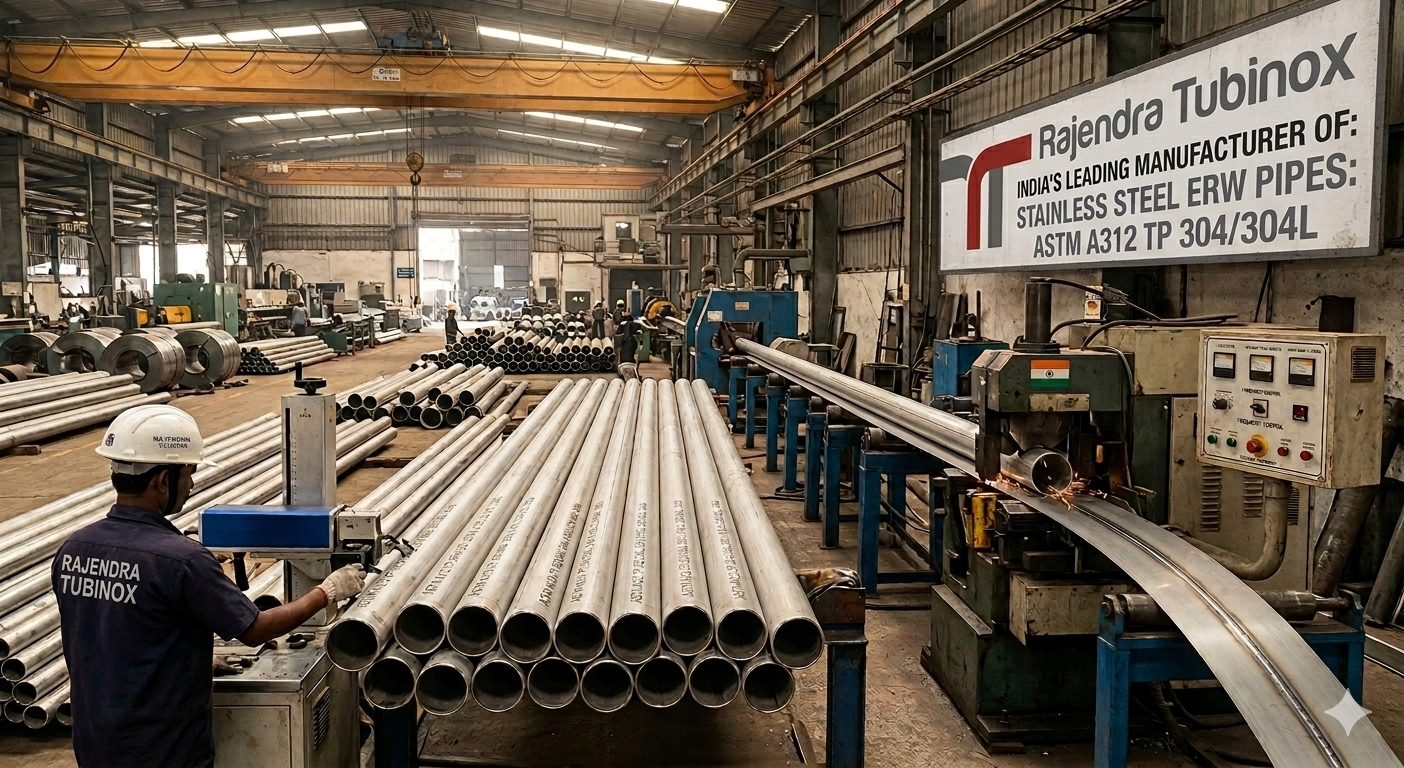
ASTM A312 TP 304 / 304L stainless steel pipes belong to the austenitic stainless steel family, which is known for excellent corrosion resistance, high ductility, and strong mechanical performance. These pipes are commonly used in industrial systems where exposure to moisture, chemicals, and elevated temperatures may occur.
ASTM A312 TP 304 ERW pipes are manufactured by forming stainless steel coils into cylindrical shapes and joining the edges using high-frequency electric resistance welding. This process creates a longitudinal weld seam that is strong and consistent throughout the pipe length. The resulting pipes offer excellent dimensional accuracy and are suitable for transporting fluids and gases in industrial environments.
The main difference between the two grades lies in carbon content. Grade 304 contains a maximum carbon content of approximately 0.08%, whereas grade 304L contains a lower carbon content of about 0.03%. The reduced carbon level improves resistance to intergranular corrosion after welding, making TP 304L pipes ideal for applications involving extensive fabrication and welding.
Both grades offer several important material characteristics that make them suitable for industrial piping systems. They provide strong resistance to oxidation, maintain structural strength across a wide temperature range, and exhibit excellent formability during fabrication processes. These properties contribute to their widespread use in chemical processing plants, food manufacturing systems, and water treatment infrastructure.
Stainless steel pipes manufactured under ASTM A312 must meet strict requirements related to chemical composition, mechanical performance, dimensional accuracy, and testing procedures. These specifications ensure that the pipes can safely operate in industrial pressure systems and corrosive environments.
The ASTM A312 standard defines the requirements for austenitic stainless steel pipes used in high-temperature and corrosive service. It specifies manufacturing methods, testing procedures, allowable tolerances, and mechanical performance criteria.
ASTM A312 TP 304 / 304L ERW pipes are available in various diameters and thicknesses to meet the requirements of different industrial piping systems.
| Specification | Details |
|---|---|
| Standard | ASTM A312 / ASME SA312 |
| Material Grade | TP 304 / TP 304L |
| Pipe Type | Electric Resistance Welded (ERW) |
| Size Range | ½” NB to 24” NB |
| Wall Thickness | Schedule 5S to Schedule 80S |
| Length | 6 meters standard or custom length |
| End Type | Plain End / Beveled End |
Surface finishing processes such as annealing, pickling, and polishing are used to improve corrosion resistance and surface quality. Pipe ends may be supplied as plain ends or beveled ends depending on welding requirements during installation.
The chemical composition of stainless steel determines its corrosion resistance, strength, and mechanical performance. Chromium forms a protective oxide layer that prevents rust formation, while nickel improves ductility and resistance to corrosion.
| Element | 304 (%) | 304L (%) |
|---|---|---|
| Carbon | 0.08 max | 0.03 max |
| Chromium | 18 – 20 | 18 – 20 |
| Nickel | 8 – 10.5 | 8 – 12 |
| Manganese | 2 max | 2 max |
| Silicon | 1 max | 1 max |
| Phosphorus | 0.045 max | 0.045 max |
| Sulfur | 0.03 max | 0.03 max |
Chromium provides corrosion resistance by forming a passive oxide film on the steel surface. Nickel enhances the toughness and ductility of the alloy, allowing the material to perform effectively in both high-temperature and cryogenic environments.
The combined presence of chromium and nickel allows stainless steel pipes to resist oxidation, rusting, and chemical attack. This protective characteristic makes TP 304 and TP 304L pipes suitable for corrosive industrial environments.
Mechanical properties define how the material behaves under stress, pressure, and temperature conditions.
| Property | Value |
|---|---|
| Tensile Strength | 515 MPa minimum |
| Yield Strength | 205 MPa minimum |
| Elongation | 35% minimum |
| Hardness | 201 HB maximum |
The mechanical strength of TP 304 and TP 304L pipes enables them to withstand internal pressure and external mechanical loads during industrial operation. Their high elongation capacity also allows the pipes to absorb stress without cracking.
Austenitic stainless steel pipes maintain strength and corrosion resistance across a wide temperature range. This makes them suitable for applications involving elevated temperatures and fluctuating pressure conditions.
International projects often require cross-referencing of material grades across different global standards.
| Standard | Equivalent Grade |
|---|---|
| ASTM | A312 TP304 / TP304L |
| UNS | S30400 / S30403 |
| EN | 1.4301 / 1.4307 |
| DIN | X5CrNi18-10 |
| JIS | SUS 304 / SUS 304L |
These equivalent standards allow engineers and procurement teams to match stainless steel materials across global supply chains.
Material equivalency ensures that the pipes can be used in projects governed by different engineering codes and international specifications.
The manufacturing process begins with stainless steel coils that are inspected for chemical composition and mechanical properties. Only materials meeting ASTM specifications are used for pipe production.
During ERW manufacturing, stainless steel strips are formed into cylindrical shapes through progressive rolling operations. High-frequency electrical current heats the edges of the strip, allowing them to fuse together and create a longitudinal weld seam.
After welding, pipes may undergo heat treatment and surface finishing processes such as annealing and pickling. These steps improve corrosion resistance and remove surface impurities.
Rajendra Tubinox maintains manufacturing processes designed to ensure consistent quality and dimensional accuracy. Production infrastructure includes pipe forming equipment, welding systems, finishing facilities, and inspection tools used to verify product performance.
Modern pipe forming lines and welding equipment allow efficient manufacturing of stainless steel ERW pipes in various sizes and schedules.
Quality control procedures include inspection of raw materials, monitoring of welding operations, and dimensional verification during production.
Pipes are manufactured in accordance with ASTM standards to ensure reliability for industrial applications.
| Outside Diameter | Thickness | Schedule |
|---|---|---|
| ½” | 1.65 mm | SCH 5S |
| 1” | 2.11 mm | SCH 10S |
| 2” | 2.77 mm | SCH 40S |
| 4” | 3.56 mm | SCH 80S |
Standard pipe lengths are typically supplied at 6 meters, although custom lengths may be manufactured according to project specifications.
Manufacturers may produce pipes in customized sizes or thicknesses depending on industrial project requirements.
Stainless steel pipes are used for transporting crude oil, natural gas, and process fluids.
Corrosion-resistant pipes are essential for handling chemicals and aggressive process media.
Hygienic stainless steel piping systems are widely used for sanitary fluid transport.
Stainless steel piping systems are used for water distribution, desalination plants, and power plant infrastructure.
Hydrostatic testing verifies the ability of the pipe to withstand internal pressure without leakage.
Non-destructive testing techniques detect surface and internal defects within the pipe structure.
PMI testing confirms that the chemical composition of the material matches the specified grade.
Pipes are bundled or packed in wooden crates to protect them during transport.
Each pipe is marked with grade, size, heat number, and manufacturing standard.
Export packaging ensures safe international shipping for project deliveries.
Selecting a reliable manufacturer is important for ensuring the performance and durability of industrial piping systems. Rajendra Tubinox focuses on manufacturing stainless steel pipes that meet strict quality standards and project requirements.
Companies seeking high-quality stainless steel pipes for industrial projects can contact Rajendra Tubinox for product inquiries and pricing information.
ASTM A312 TP 304 ERW pipes are commonly used in chemical plants, food processing systems, water treatment plants, and industrial piping networks.
The main difference is carbon content. Grade 304 contains slightly higher carbon levels, while 304L contains lower carbon levels that improve weldability.
Yes, ERW pipes manufactured according to ASTM standards are designed to handle industrial pressure and corrosion-resistant applications.
Typical pipe sizes range from ½ inch to 24 inches with various wall thickness schedules depending on project requirements.